03 / Walk guide
How to Catwalk: Runway Walk vs Everyday Walk
Knowing how to catwalk means knowing what to change from your everyday walk. It is the same body and mostly the same movement, with five details turned up.
 Save this guide to Pinterest
5 differences on the catwalk
- 01
Feet closer to one line
In an everyday walk, your feet land on two tracks about hip-width apart. On the catwalk, they land close to a single line. This narrows your base and creates the gentle hip movement people associate with a runway walk.
TipClose to the line, never crossing it. Crossing makes you wobble.
- 02
A steady, deliberate tempo
Everyday walking speeds up and slows down with what you are doing. A runway walk holds one steady beat from start to finish, often set by the music. It looks slower and more intentional.
- 03
Eyes fixed ahead
Day to day, your eyes move around. On the catwalk, they lock onto one point at eye level at the end of the runway, usually the photographers. That fixed gaze keeps your head still.
- 04
A quieter upper body
Your legs and hips do the walking; your shoulders, chest and head stay calm. Arms hang long with a small swing, or almost none, depending on the show.
- 05
A pause and a turn
An everyday walk just stops. A catwalk has a clear end: you pause for a beat or two, hold a moment for the cameras, then turn cleanly and walk back.
TipSee runway turns and pauses for how to turn without a wobble.
Catwalk vs runway walk
The words mean the same thing. “Catwalk” is the older word and comes from the narrow walkway itself; “runway walk” is more common in the US. Some people use “ramp walk” too. Whatever you call it, the walk is the same.
Why the runway walk looks the way it does
A runway walk is designed to show clothes. A narrow line makes fabric move. A steady tempo gives photographers a predictable rhythm. A still head and upper body keep the attention on the clothes, not the person fidgeting in them. Once you know that, every detail makes sense. Nothing is there just for drama.
Switching between the two
The easiest way to learn the catwalk is to start from your everyday walk and change one thing at a time:
- Walk normally across the room.
- Walk it again with your feet landing closer to one line.
- Again, holding a steady count.
- Again, eyes fixed on one point.
- Again, arms loose and shoulders still.
- Finally, add a pause at the end and turn.
By the last pass you are doing a catwalk. Film the first and the last to see the difference.
Will it change my everyday walk?
A bit, and in a good way. Practising the catwalk tends to make your everyday walk steadier, taller and less rushed, even when you are not thinking about it. The foot placement relaxes back to normal on its own. For the full basics, see how to walk like a model, and for the tempo and line in more detail, read runway walking.
Questions
Can anyone learn to catwalk?
Yes. The catwalk is a set of learnable details: foot placement, tempo, gaze and a quiet upper body. None of them depend on height or build.
Should my hips sway?
A little, as a result of placing your feet close to one line. Don’t add the sway on purpose; forced hip movement throws off your balance.
Common mistakes
- Crossing your feet over each other to exaggerate the line.
- Stomping to look powerful. A runway walk is strong but light.
- Swinging your hips on purpose. The movement should come from foot placement.
- Using the runway walk everywhere. It is a performance, not a daily habit.
Défilé · Runway line
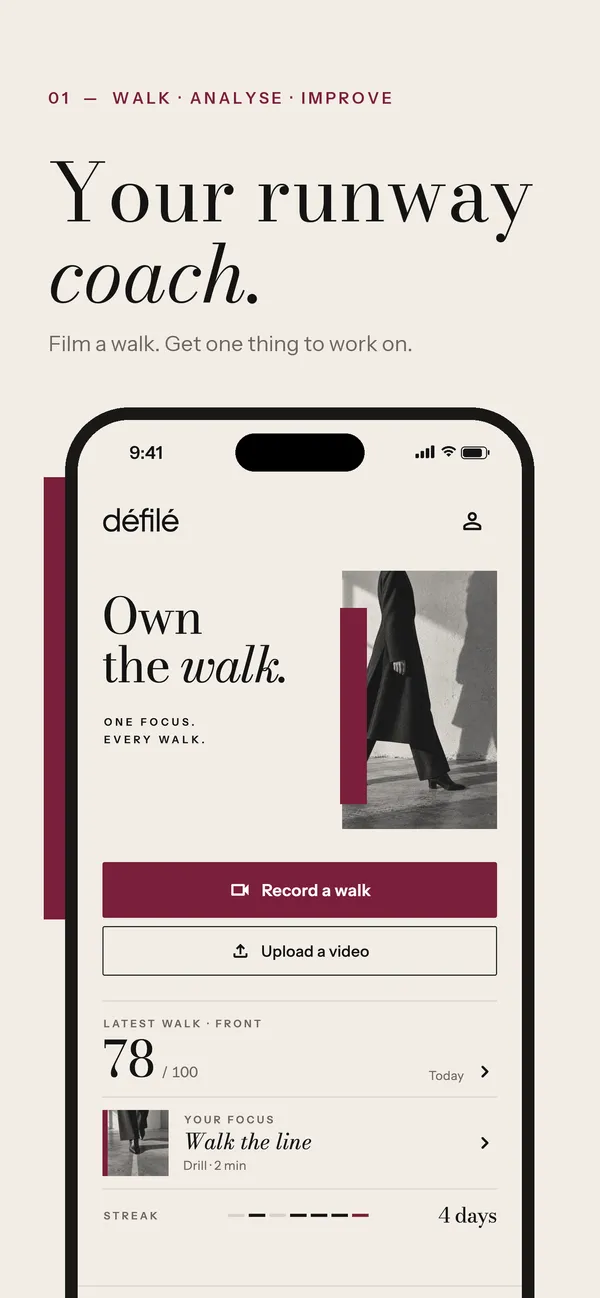
Catwalk down your hallway and see your runway line score.
Film a walk and Défilé scores it out of 100, shows you the one thing holding it back and gives you a short drill to fix it. Your video never leaves your phone.
 On Android? Défilé is coming soon to Google Play.