03 / Walk guide
Runway Walking: Pace, Beat and Your Runway Line
A runway walk rests on two measurable things: your beat and your line. Get the tempo steady and your feet landing close to one line, and everything else has something to sit on.
 Save this guide to Pinterest
Beat and line
- 01
Find your natural pace
Walk across a room normally and count your steps for fifteen seconds, then multiply by four. That is your natural tempo in steps per minute. Most people land somewhere between 100 and 120. Your runway pace will be close to it, often a little slower.
TipWrite the number down. It is your baseline.
- 02
Hold the beat
Choose a tempo and keep it from your first step to your last. The most common beginner problem is speeding up in the middle, especially when nervous. A metronome app or a song with a clear beat makes it easy to practise.
TipMany runway shows use music between 110 and 130 beats per minute. Practise to a few different speeds.
- 03
Draw your runway line
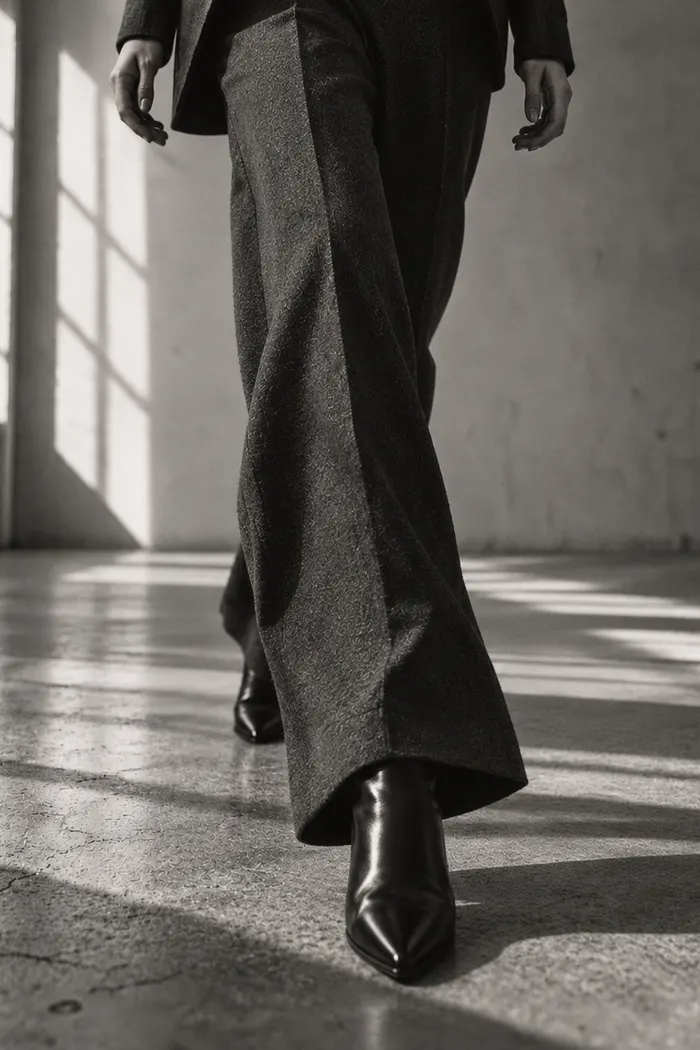
Your runway line is the path your feet trace. Aim for each foot to land close to one straight line, one in front of the other, with the inside edges nearly brushing it. Not crossing it.
- 04
Keep your line straight to the end
Many people start on a line and drift off it as they get closer to the end. Keep your eyes on your point and your line stays straight. Where you look is where you go.
- 05
Match stride to beat
Beat and stride length are linked. If you slow the beat, don’t lengthen the step to compensate; you will overstride and bounce. Keep the step the same and just move a little slower.
Why beat and line matter so much
They are the two parts of a runway walk that you can measure. A steady beat makes a walk look calm and intentional. A clean line makes it look polished. When either is off, people notice, even if they can’t say what is wrong. It just looks rushed or wobbly.
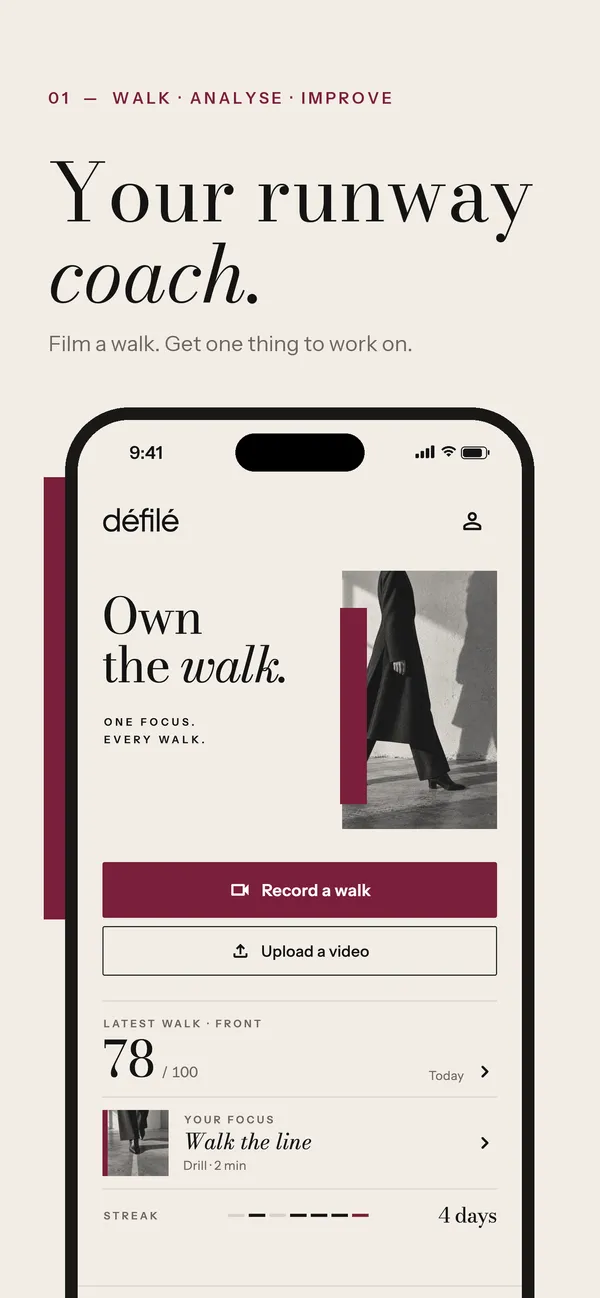
That is also why Défilé scores them separately: tempo for your beat and consistency, and runway line for how close your feet land to one line and how steady your upper body stays above them.
Tempo drill: the metronome walk
- Set a metronome to your natural pace.
- Walk five lengths, one step per click.
- Drop the tempo by 5 beats per minute. Walk five more.
- Drop another 5. Walk five more.
- Turn it off and walk at the slowest pace from memory.
Line drill: the tape walk
- Put a three-metre strip of tape on the floor.
- Walk it slowly with each foot landing just beside the tape.
- Film from the front with the camera at the end of the tape.
- Watch it back: do your feet stay beside the tape to the end?
- Repeat without the tape, then check the video again.
Put them together
When both feel natural, combine them: walk the line to a steady count. That is the core of a runway walk. Add a still head and fixed gaze and relaxed arms, and learn the runway turn to finish.
Questions
What is a good runway walk tempo?
There is no single right number. Many shows use music between about 110 and 130 beats per minute. Practise at a few speeds so you can adapt.
Why do I drift off my line?
Usually because your eyes move. Lock onto a point at the end and your line tends to stay straight.
Common mistakes
- Speeding up after the first few steps.
- Letting your feet drift onto two tracks as you get tired.
- Crossing over the line, which makes the hips jut and the ankles wobble.
- Lengthening your stride when you slow down.
- Practising only to one song, so any other tempo feels wrong.
Défilé · Tempo + runway line
Défilé measures both. Film a walk and see your tempo and runway line scores.
Film a walk and Défilé scores it out of 100, shows you the one thing holding it back and gives you a short drill to fix it. Your video never leaves your phone.
 On Android? Défilé is coming soon to Google Play.