03 / Walk guide
Runway Turns and Pauses
The end of the runway is where a walk is won or lost. A clean pause and a smooth turn make even a simple walk look finished. Here is how to do both.
 Save this guide to Pinterest
Pause, turn, walk back
- 01
Slow into the stop
Don’t brake suddenly. Over your last two steps, keep the same beat but let the steps get slightly shorter, so you arrive at your mark balanced, not leaning forward.
TipKnow where your mark is before you start walking.
- 02
Land in a stable stance
Stop with one foot slightly in front of the other and your weight mostly on the back leg. This is more stable than feet together, and it gives the camera a better line.
- 03
Hold for two beats
Stand still. Eyes forward, face soft, shoulders down. Two beats is long enough to be seen and short enough not to feel awkward. Don’t fidget, adjust your clothes or look away.
TipBreathe out during the pause. It stops you holding the tension in your face.
- 04
Pivot on the balls of your feet
Shift your weight onto the balls of both feet and turn through your hips, letting your feet swivel. Your head turns last: keep your eyes on your point until your body has turned, then snap your eyes to the new point.
- 05
Walk back on the same line
After the turn, take your first step on the same line you arrived on, at the same beat. Many people rush the return walk. Keep it identical to the walk in.
TipPick your point for the walk back before you start the turn.
Why the pause matters
The pause is the moment people look at you properly. On a runway it is for the photographers; in a room, it is the half-second where you let people see you before you move on. Most beginners skip it because stillness feels exposing. But a confident pause is one of the clearest signals of ease you can give.
Two common turns
- The pivot turn: the one above. Clean, simple, works in any shoes. Start with this.
- The half turn with a look back: after the pivot, walk two steps, then glance back over your shoulder for a beat before continuing. It is more editorial and needs a very steady walk.
Turn drill
- Put a mark on the floor at the end of your walking space.
- Walk to it, stop, hold for two beats. Don’t turn yet. Repeat five times.
- Stand on the mark and practise just the pivot, ten times each direction.
- Put it together: walk, stop, pause, pivot, walk back.
- Film it from the front, where the “photographers” would be.
Turns in heels
In heels, the pivot happens on the balls of your feet with the heels lifted slightly off the floor. Keep the turn small and controlled, and shorten your last two steps a little more than in flats. Practise in flats first, then in block heels, before you try it in stilettos.
For the walk itself, see runway walking. To see your whole walk as others do, read film and review your own walk.
Questions
Which way should I turn?
Either way, but be consistent. Many people find turning towards their dominant side easier. Practise both so you can adapt to the space.
How long should the pause be?
About two beats of your walking tempo. Long enough to be seen, short enough not to stall.
Common mistakes
- Stopping so suddenly you rock forward.
- Turning with lots of small steps, which looks unsure.
- Turning your head first, which unbalances the body.
- Skipping the pause or cutting it short.
- Rushing the walk back once the ‘important’ part is over.
Défilé · Walk score
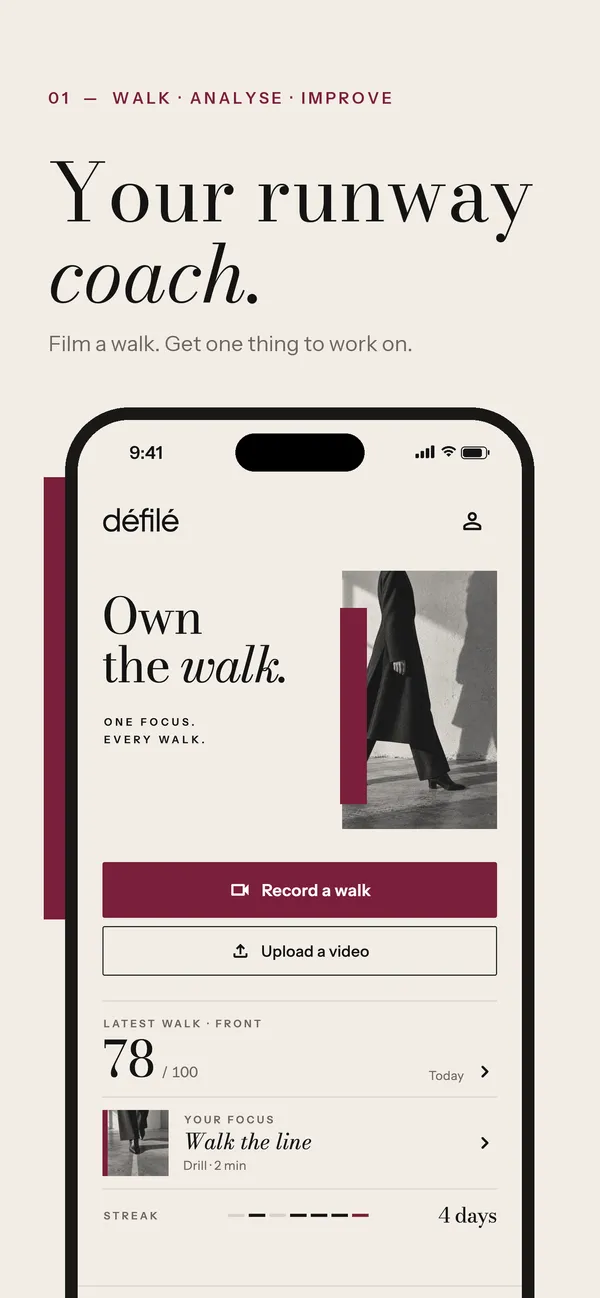
Film a full walk with the turn and see your walk score.
Film a walk and Défilé scores it out of 100, shows you the one thing holding it back and gives you a short drill to fix it. Your video never leaves your phone.
 On Android? Défilé is coming soon to Google Play.