03 / Walk guide
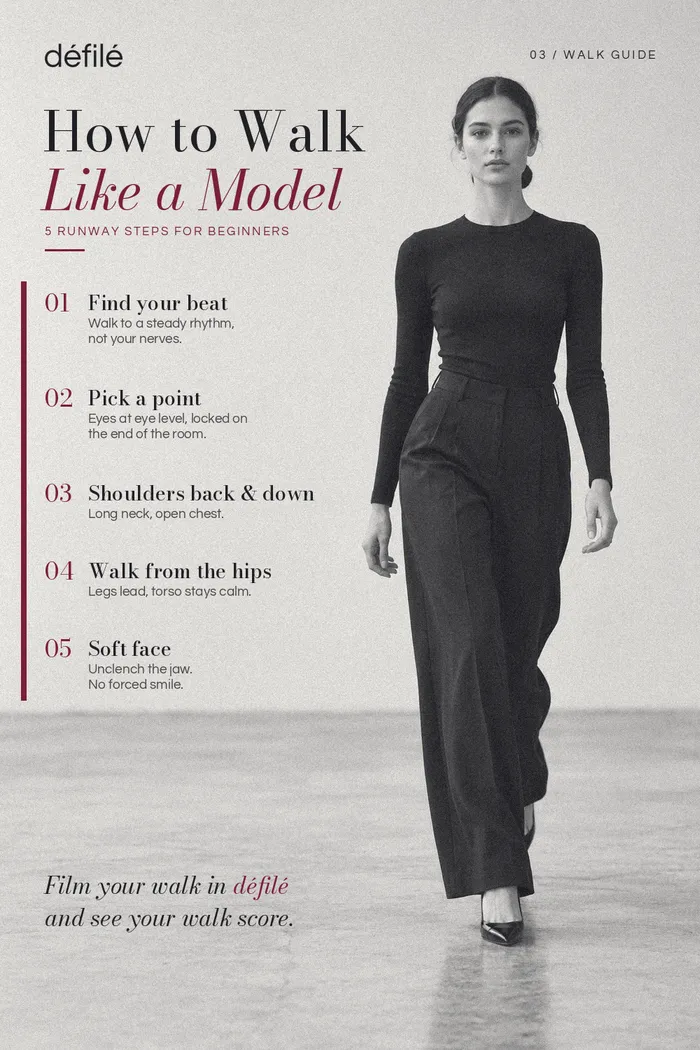
How to Walk Like a Model: 5 Runway Steps for Beginners
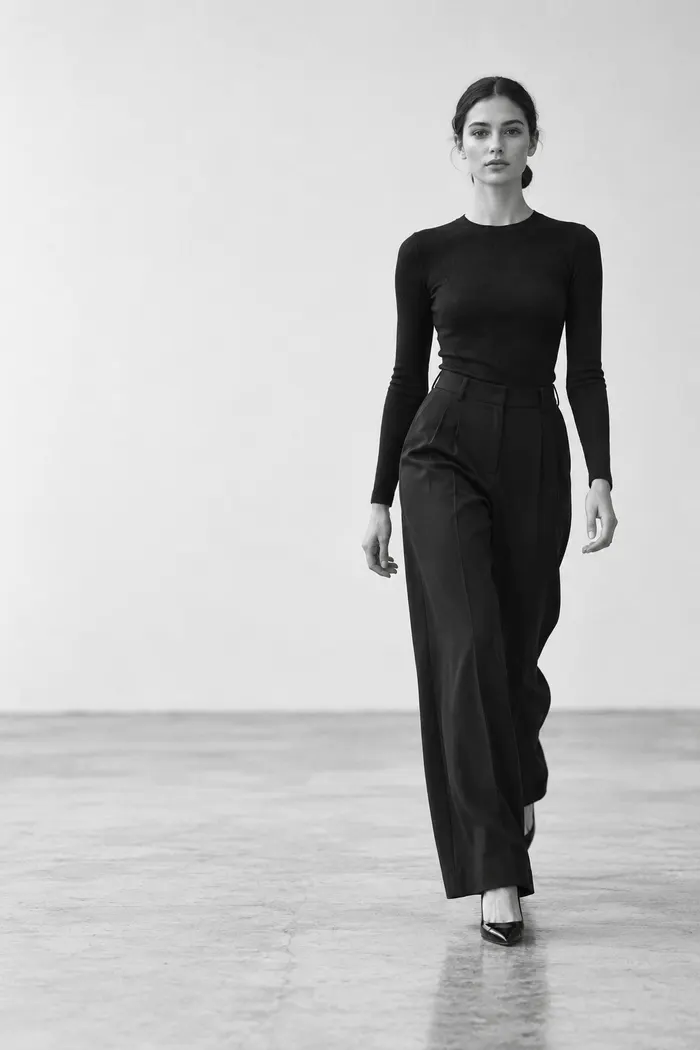
Learning how to walk like a model is about five simple things happening at once. Learn them one at a time, in this order, and they add up to a runway walk.
 Save this guide to Pinterest
5 runway steps for beginners
- 01
Find your beat
Walk to a steady rhythm, not to your nerves. Pick a tempo you could nod along to and let every step land on it. Nerves speed you up; a beat keeps every step the same length, which is what makes a model walk look unhurried.
TipCount “one, two” under your breath for your first ten steps. Most beginners settle around 110 to 120 steps a minute.
- 02
Pick a point
Choose a spot at eye level at the far end of the room and keep your eyes on it. Looking down drops your chin and rounds your shoulders. A fixed point keeps your head still and pulls your walk into a straight line.
TipLock onto something real, like a door handle or a picture frame, not “the distance”.
- 03
Shoulders back and down
Draw your shoulder blades gently back, then let them slide down, away from your ears. Your neck gets longer and your chest opens without pushing forward. This gives you a long, open line from the side.
TipDon’t pinch your shoulder blades together. It should feel like settling, not squeezing.
- 04
Walk from the hips
Let the movement start at your hips. Your legs reach forward while your upper body stays calm. Place each foot close to a straight line in front of the other, without crossing over it.
TipIf your head bobs when you watch it back, shorten your stride a little.
- 05
Soft face
Tension shows in the jaw first. Let your teeth part slightly, relax your forehead and skip the forced smile. A calm face reads as confident, and it is the last thing people remember.
TipBreathe out through your nose just before your first step.
Why these five, in this order
Each step fixes the one before it. A steady beat gives you even steps. A fixed point keeps your head still, which keeps your shoulders level. Level shoulders let your hips do the work. And when your body is calm, your face can be too.
That is also why it helps to learn them one at a time. If you try all five at once, you end up thinking about everything and walking stiffly. Give each step two or three walks of its own before you add the next.
A five-minute practice
- Clear about five metres of floor. A floor seam or a strip of tape makes a good line.
- Walk it three times, thinking only about your beat.
- Walk it three more times with your eyes locked on a point.
- Add your shoulders, then your hips, one walk at a time.
- Finish with two walks where you think about nothing but a soft face.
- Film one walk from the front and watch it back.
When you watch it, check three things: is your head still, do your feet land near one line, and does your speed stay the same from start to finish? If one of those is off, that is your next thing to practise, not all five.
Runway walk or everyday walk?
You don’t need to walk like this to the shops. But practising the runway version makes your everyday walk better on its own: steadier, taller and less rushed. Think of the runway walk as the drill and your everyday walk as the result. For the difference in detail, read how to catwalk.
Where to go next
Once the five steps feel natural, work on the details that take a walk from good to polished: your stride length, where to look and what to do with your arms. If you are not sure where to start, take the walk types quiz.
Questions
How long does it take to learn to walk like a model?
Most people see a clear difference within two weeks of ten-minute daily practice. Making it automatic, so you walk that way without thinking, usually takes a month or two.
Do I need heels to practise?
No. Learn the five steps in flat shoes first. Heels add balance to the list of things to think about, so they are easier once the basics are automatic.
Common mistakes
- Walking to your nerves. Speeding up halfway is the most common beginner mistake.
- Watching your feet. Your chin drops and your shoulders follow.
- Crossing one foot over the other to fake a runway line. Land close to the line, not across it.
- Swinging from the shoulders instead of the hips, which makes your upper body rock.
- Holding your breath. It tightens your face and your arms.
Défilé · Walk score
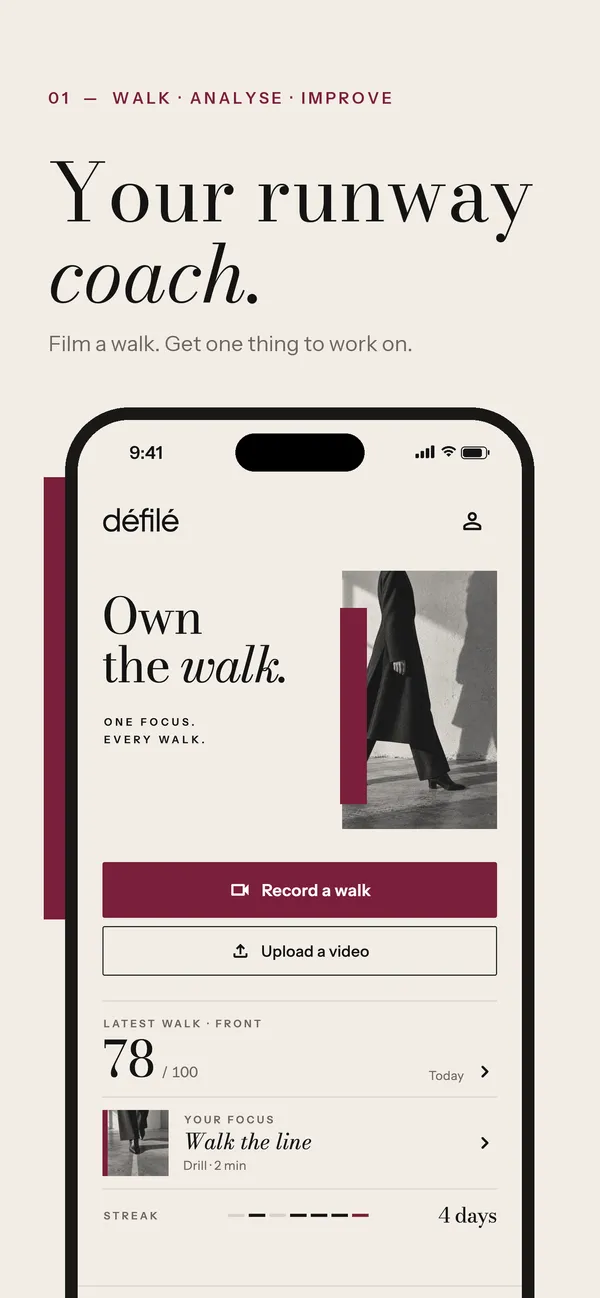
Film your walk in Défilé and see your walk score.
Film a walk and Défilé scores it out of 100, shows you the one thing holding it back and gives you a short drill to fix it. Your video never leaves your phone.
 On Android? Défilé is coming soon to Google Play.