03 / Walk guide
Which Walker Are You? The 4 Walk Types
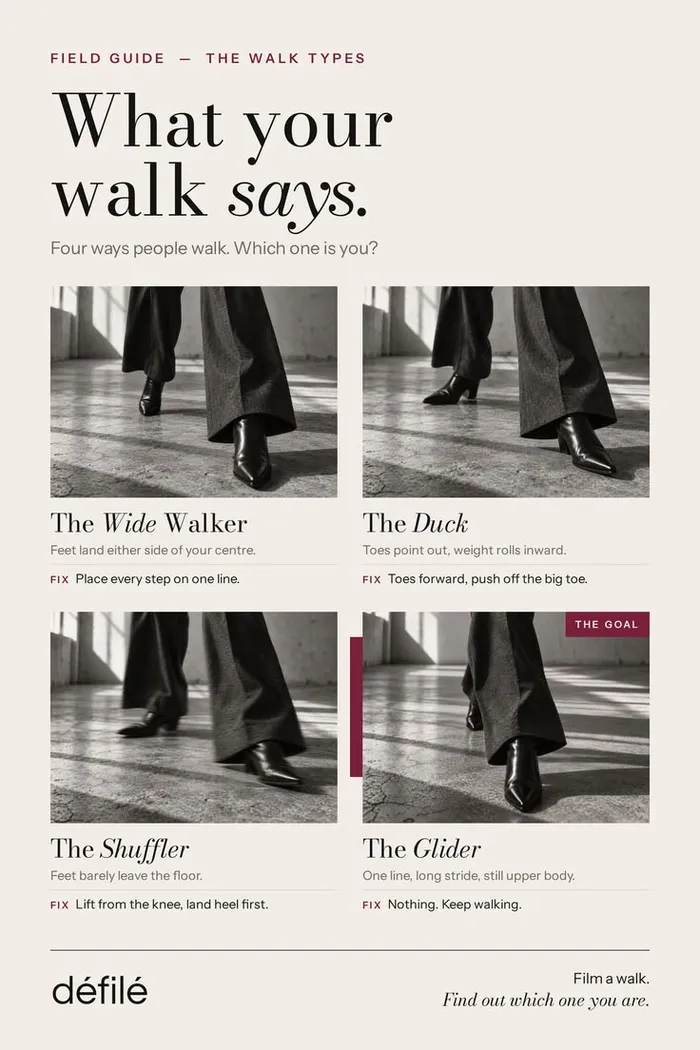
Most people fall into one of four walk types. Each one has a single fix that moves it closer to a model walk. Take the quiz, then read your fix below.
 Save this guide to Pinterest
The 4 walk types
- 01
The Wide Walker
Your feet land on two separate tracks, roughly hip-width apart, and your body rocks side to side to follow them. It feels stable but reads as heavy on camera. The fix is to bring your feet closer to one line, without crossing it.
TipWalk along a floor seam and let each foot land just beside it.
- 02
The Duck
Your toes point out and your foot rolls in as you push off. It usually starts at the hips, not the feet, so turning your toes in by force won’t hold. The fix is to point your knees forward and let your feet follow.
TipLine up your second toe with the middle of your knee for ten slow steps.
- 03
The Shuffler
Small, quick steps, low eyes and feet that barely leave the floor. It is the walk of someone trying not to be noticed. The fix is to lift your gaze and let your stride open up.
TipPick a point at eye level at the end of the room and don’t let go of it.
- 04
The Glider
A steady beat, a quiet upper body and feet that land close to one line. You already have the base of a runway walk. The fix is polish: a pause at the end, relaxed arms and a clean turn.
TipFilm yourself from the front to check your line really is straight.
How to check your walk type without the quiz
The quiz is a good start, but a ten-second video is better. Prop your phone at hip height at the end of a hallway and walk towards it at your normal pace. Then watch it back at half speed and look for three things:
- Where your feet land. Two tracks, toes out, short steps or one line?
- What your head does. Still, bobbing or dropping?
- What your arms do. Swinging out, stuck, busy, or swinging forward and back?
Most people are a mix of two types. That’s normal. Pick the one that shows up most in your video and start there.
Why walk type matters for a model walk
A model walk is built on a few basics: an even beat, a still head and feet landing close to a single line. Each walk type breaks one of those basics in a predictable way. The Wide Walker loses the line, the Duck loses the forward direction, the Shuffler loses the beat and the gaze. That is good news, because it means one targeted fix does more than ten general tips.
A one-week plan for any type
- Day 1: Film a front-view walk. Note your type.
- Days 2 to 4: Five minutes a day on the one fix for your type.
- Day 5: Film again from the same spot, at the same distance.
- Days 6 and 7: Add the 5 runway steps on top of your fix.
Compare the two videos side by side. You are looking for one change, not a new walk. When your type’s fix feels automatic, move on to stride length or your arms.
Questions
Can my walk type change?
Yes. Walk types are habits, not fixed traits. With a few weeks of practice on the fix for your type, most people move towards the Glider.
I got a different result from my video than from the quiz. Which is right?
Trust the video. The quiz is based on how your walk feels, and the video shows how it actually looks. Many people find they are a mix of two types.
Common mistakes
- Trying to fix everything at once. Pick the one fix for your type and give it a week.
- Forcing your toes straight. If you are a Duck, work from the knees and hips.
- Overcorrecting a wide walk into a crossover walk. Close to the line, not over it.
- Answering the quiz for the walk you want, not the one you have.
Défilé · Runway line
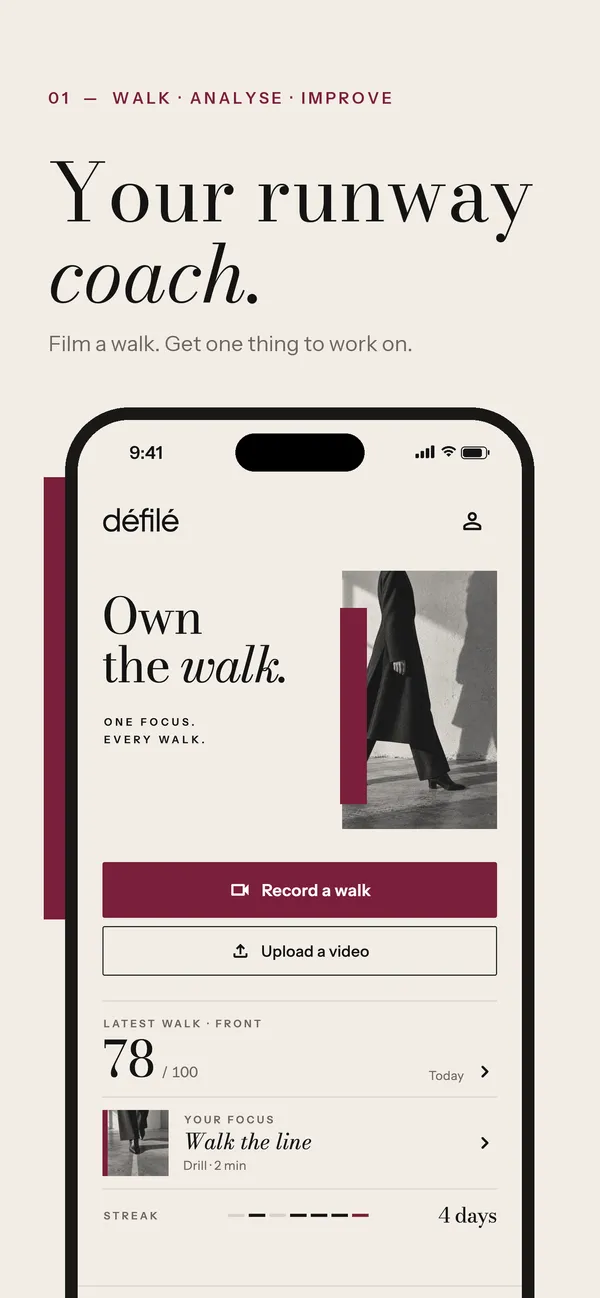
Find out your real walk type. Film a walk and see your runway line score.
Film a walk and Défilé scores it out of 100, shows you the one thing holding it back and gives you a short drill to fix it. Your video never leaves your phone.
 On Android? Défilé is coming soon to Google Play.